Website vs. Online Store vs. Web App: What Your Small Business Actually Needs
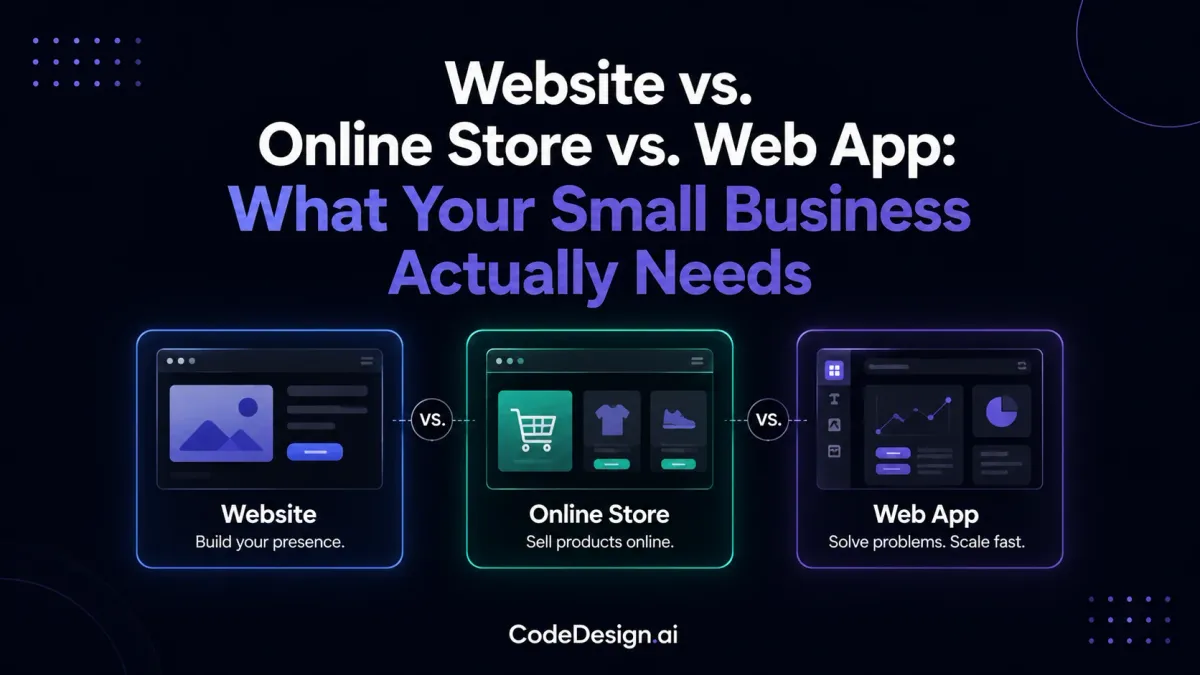
Website, online store, and web app describe three distinct types of project, not three labels for the same thing. They differ in architecture, build cost, delivery timeline, and the level of maintenance each requires after launch. Treating them as interchangeable is one of the most common reasons a digital project exceeds its budget.
The first decision is therefore not which platform to choose, but which category the business actually needs. The clearest way to determine that is to define what a visitor should be able to do on the page. If the goal is to read information and make contact, the answer is a website. If the goal is to purchase, it is an online store. If the goal is to sign in and complete tasks repeatedly over time, it is a web app. Most small businesses need only one of these at launch. When the requirements fall across two categories, many owners engage web development services for small business to define the scope and technical specification before development begins. That step is not always necessary, but understanding the distinction is.
Three categories, three purposes
Each option serves a different function and carries a different technical footprint. The sections below outline what each one is, the tools associated with it, and the conditions under which it is the correct choice.
The website
A website serves an informational purpose: it presents what the business does, establishes credibility, and directs visitors toward a defined contact action such as a phone call, a form submission, or a booking link. For many service businesses (law firms, dental practices, electricians, accounting firms), a well-structured website meets the entire requirement.
Squarespace, Codedesign.ai, Wix, and WordPress cover this category, with build times typically measured in days rather than weeks. The performance priorities are specific: fast load times, clear navigation, mobile responsiveness, and accurate contact information. Page speed and Core Web Vitals have a measurable effect on both search ranking and bounce rate, which makes technical performance more important than visual complexity at this stage.
The online store
An online store introduces transactional functionality. The build now includes a shopping cart, a checkout process, payment gateway integration, a product catalog, inventory management, shipping rules, and tax calculation. This is a transactional system rather than a set of static pages.
Hosted platforms such as Shopify and BigCommerce manage the underlying infrastructure for the merchant, including hosting, security, and PCI DSS compliance. WooCommerce takes a different approach: as a self-hosted WordPress plugin, it offers greater customization but returns responsibility for hosting, security, and updates to the business. The operational stakes are higher than on a brochure site because conversion depends directly on checkout performance. A single point of friction in the checkout flow reduces completed orders, and the cause is often difficult to identify without analytics.
Store requirements expand considerably in business-to-business commerce. A review of successful Shopify B2B websites examples illustrates the additional functionality involved: customer-specific pricing, gated catalogs, bulk and quantity-based ordering, and net payment terms. None of these are part of a standard direct-to-consumer configuration.
The web app
A web app differs from the other two in kind rather than degree. Its purpose is functional: it allows a user to complete a defined task such as booking an appointment, tracking a shipment, managing a subscription, or accessing a personalized dashboard. Calendly, Mailchimp, and online banking portals are representative examples.
Web apps are interactive, store data associated with individual user accounts, and rely on custom application logic that off-the-shelf tools cannot fully replicate. They require authentication, a database layer, server-side processing, and frequently third-party API integrations. As a result, they carry the highest development and maintenance cost of the three, and that cost is justified when the business depends on the application to operate.
Comparing cost, timeline, and maintenance
Initial budget receives most of the attention during planning, but build time and ongoing maintenance are the factors businesses most often underestimate. The three categories increase across all three dimensions.
A website sits at the lower end: limited build effort, a delivery window of days to two weeks, and minimal maintenance beyond content updates and periodic design revisions. An online store occupies the middle: a build measured in weeks, with continuing administration of the catalog, orders, payment configuration, and shipping logic. A web app represents the most substantial commitment: a development cycle measured in months and a permanent maintenance requirement covering hosting, security patching, feature development, and user support.
The financial profile follows the same pattern. A website can be deployed for the cost of a domain and a template. A store carries additional expenses from payment processing fees, third-party applications, and custom design. A web app constitutes a separate class of investment, with recurring engineering costs that continue beyond launch. None of the three are deploy-and-forget, but the maintenance gap between an informational site and a functional application is substantial.
Determining which category applies
The appropriate choice is derived from how customers interact with the business, not from which option appears most advanced.
Begin with the single most important action a visitor should take. A request to call or obtain a quote indicates a website. An instruction to add an item to a cart indicates a store. A requirement to sign in and manage something on a recurring basis indicates a web app. This should then be assessed against the revenue model, whether income is generated through leads, direct sales, or recurring accounts, and against the level of custom functionality genuinely required.
Two scenarios demonstrate how the same business can fall into different categories. A bakery whose objective is to be found locally and attract walk-in customers requires a website with opening hours, a location map, and a menu. The same bakery accepting custom orders with online deposits requires a store. A fitness studio publishing a class schedule requires a website; the same studio enabling members to book and pay for classes requires a web app. The deciding factor in each case is the action, not the sector.
In summary, three objectives map to three answers. To be found, establish credibility, and capture leads, the requirement is a website, supported by Squarespace, Wix, or WordPress. To sell products or services directly, the requirement is an online store on Shopify, WooCommerce, or BigCommerce. To allow users to book, track, or manage accounts over time, the requirement is a web app, built either as a custom application or assembled on a platform such as Bubble or Webflow with custom logic. These categories function as a guideline rather than a strict rule, and businesses that fall between two of them (a website with a single product, or a store with a limited booking feature) are both common and reasonable.
Common and costly mistakes
Several recurring errors are straightforward to avoid once identified.
The most expensive is commissioning a web app when an online store would meet the requirement. Custom software involves longer timelines, higher cost, and greater technical risk. A business focused primarily on selling products rarely requires it. The opposite error is equally frequent: building a store but treating it as an informational site, neglecting the checkout experience, and consequently incurring high cart abandonment.
Over-specification at an early stage is another common issue. A newly launched business does not require a loyalty system or live delivery tracking from the outset. A focused initial release, followed by feature additions informed by actual user behavior, is the more efficient approach. Under-specification produces the opposite constraint, where the lowest-cost configuration becomes a limitation as the business grows.
Two further considerations are worth noting. Platform lock-in occurs when a convenient initial choice becomes costly to leave, either through ongoing fees or a difficult data migration. In addition, several costs are frequently omitted from initial estimates: payment processing fees, hosting renewals, application or plugin subscriptions, and routine maintenance. These should be accounted for before a platform decision is finalized.
Planning for growth beyond the first build
Outgrowing an initial build indicates business growth rather than a planning failure. The objective is to progress to the next category without compromising existing functionality.
The typical progression is predictable. A business launches a website, traffic increases, and a store is added as demand for online purchasing develops. The store subsequently reaches a volume that warrants customer accounts, bookings, or a self-service portal, at which point the project moves toward web application functionality. Each transition is a defined project rather than a configuration change.
One technical consideration carries disproportionate weight: during a replatforming exercise, URL structures should remain consistent and appropriate redirects should be implemented. A migration that does not preserve these elements can result in significant loss of search ranking, and recovery is often measured in months. This stage is also where external development support delivers the most value, because architectural decisions regarding data structure, integrations, and hosting are difficult and expensive to reverse later. Visual design is the more easily adjusted component.
Summing It Up
The most reliable method is to begin with the required action rather than the category label. Define the single action a visitor should complete, select the option that satisfies that requirement with the least unnecessary complexity, and specify for current operational needs rather than projected future scale. A well-executed website that converts will outperform an incomplete web application.
The limitations of the initial build become apparent when customers begin to require functionality the current setup cannot support, such as purchasing, booking, or account access. That is the point at which expansion should be planned deliberately, supported where appropriate by the right web development services for small business, rather than undertaken as an urgent rebuild. A focused initial implementation, expanded according to customer behavior, is the more sustainable approach.