
7 Strategies to Integrate Security Threat Modeling into Agile Sprint Cycles
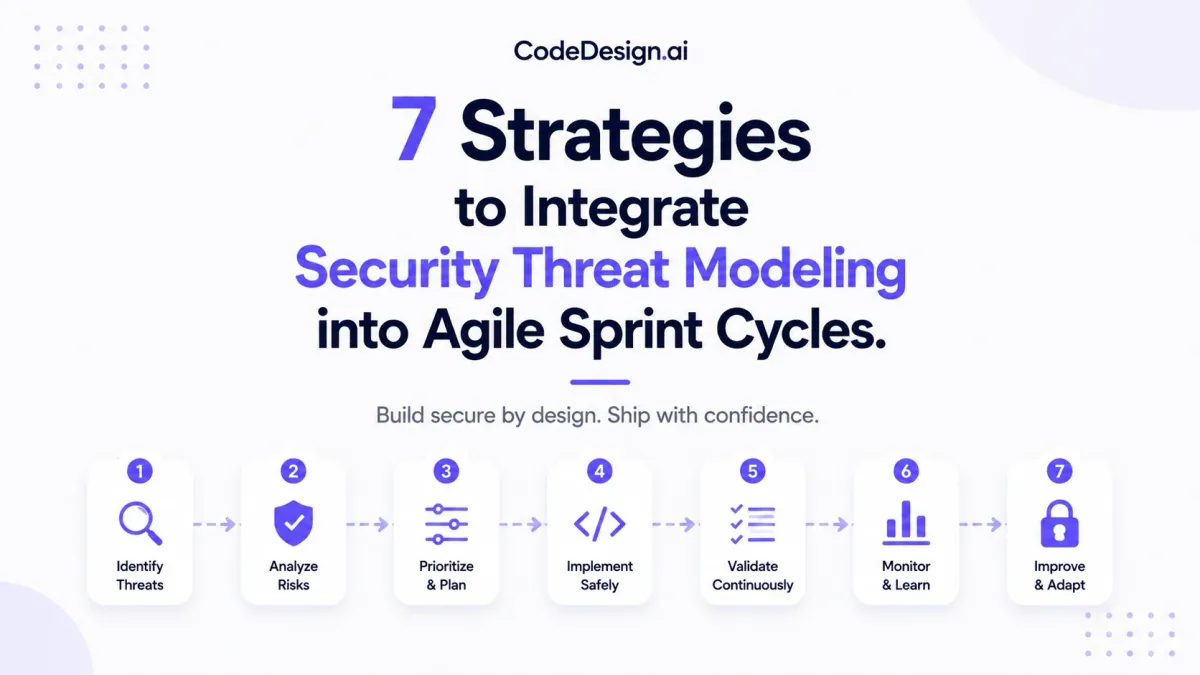
With all industries becoming more competitive, software developers aim to work fast and deliver products quickly. While risk analysis frameworks like Agile and Scrum help ensure everyone is doing their tasks, security control is often left out.
Agile methodologies have become the standard for modern development teams because they prioritize adaptability, collaboration, and speed. However, this rapid pace often creates challenges for maintaining strong security policies.
Security threats are evolving with new tools and software, so it’s always important to implement security threat modeling and similar security-savvy methods to prevent problems once the software is released.
We’ll explore the agile method today and key strategies for integrating security threat modeling in agile sprint cycles.
Agile Method Explained
Agile is a project management approach based on short, iterative cycles known as sprints. Sprints usually last two weeks, but some companies create sprints that last from one to four weeks. Unlike traditional, linear methods such as Waterfall, Agile emphasizes flexibility, customer feedback, and cross-functional teamwork.
One key characteristic of the Agile framework is iterative development. This is when threat model projects are broken down into smaller, manageable tasks to accelerate delivery, helping developers gain a better perspective on their workload.
Developers, marketers, stakeholders, and all other relevant individuals can be included throughout the sprint, providing them with insights into the progress.
Each sprint can be a valuable lesson for everyone involved, providing helpful feedback and opportunities to adapt to changes in security requirements or priorities. While Agile is great for speed and flexibility, aspects like security are often overlooked or not adequately considered.
This gap creates a need for structured approaches, such as threat modeling, that can operate within Agile constraints.
What’s Security Threat Modeling?
As a proactive process, security threat modeling helps developers identify and address potential problems and security risks before attackers (known as threat agents) can exploit them. Rather than waiting for vulnerabilities to surface during testing or, worse, during deployment, threat modeling helps prevent them from surfacing on time.
The process involves mapping out a system’s architecture, pinpointing assets that need protection, and predicting how those assets could be attacked. Common frameworks such as STRIDE (Spoofing, Tampering, Repudiation, Information Disclosure, Denial of Service, Elevation of Privilege) and PASTA (Process for Attack Simulation and Threat Analysis) provide structured methods for evaluating threats.
Developers should remember that PASTA isn’t only a type of food but also a way to ensure their software is protected against vulnerabilities. In Agile environments, it’s challenging to incorporate these frameworks into sprints, which are often fast-paced.
Top 7 Strategies for Integrating Security Threat Modeling in Agile Sprint Cycles
Integrating security threat modeling into Agile workflows requires cultural changes and changes in how developers operate. The good news is that the development process doesn’t have to suffer because of security considerations.
However, it’s crucial to find the right strategies to ensure this is true. We’ll explore seven effective strategies for integrating security threat modeling, but there are many more. Some methods might require time and resources, while others can be effortlessly implemented.
Let's dive into the threat modeling methods.
Shift Security Left in the Agile Workflow
Companies often leave security considerations for the end stages. While this can be great for a quicker start, it makes security seem the least priority. In Agile workflows, shifting security left can be very helpful.
This means that security considerations should be a part of the earliest stages of product development, starting with planning, design, and architecture. This approach ensures you identify potential risks before any code is written, significantly reducing remediation costs and preventing delays later in the cycle.
With this strategy, security checks and opinions can be addressed early, making the development of threat models for security features much easier. This doesn’t disrupt the sprints; instead, it makes security a part of them.
Embed Threat Modeling Processes into Sprint Planning
Sprint planning sessions set the tone for what the team will accomplish in each iteration, and by including threat modeling, security is ensured to be part of the conversation. For example, when new features are introduced, the team should map out possible attack vectors.
This allows them to determine which safeguards are necessary. Including this step in sprint planning creates a repeatable habit where security becomes as integral as functionality or performance.
As already discussed, this will mean that security won’t be a one-time process once everything is completed, but something that is continuously thought about and worked on. Of course, some sprints will require more hours and effort to secure, while others will have few tasks. Regardless, employees will be aware of security implications.
Define Security Roles and Responsibilities
The Agile framework can’t be separated from collaboration and communication processes. It makes it easier to define different roles and responsibilities for different employees. This feature of Agile methodology is quite important in the context of integrating security threat modeling.
To prevent security tasks from slipping through the cracks, project managers should properly assign personnel to handle them for all future tasks. This strategy will vastly depend on the company's structure.
Some companies outsource cybersecurity tasks, while others rely on in-house specialists or developers with security expertise.
If there isn’t a dedicated person responsible for cyber security risks on each team, hiring one should be a priority. However, those responsible for security controls have extremely accountable roles. Some form of oversight should be implemented to prevent insider threats.
Employee monitoring solutions can be implemented to prevent security issues within the organization. There should always be a trust boundary at the workplace. Keep in mind that many insider threat problems are accidents.
Monitoring tools can detect unusual activity, prevent data leaks, and flag potential insider risks. This can be quite helpful in preventing various problems, but it’s also important to walk the thin line between intrusion and safety.
Use Lightweight Threat Modeling Frameworks
Agile teams need tools that don’t slow them down. Lightweight frameworks such as STRIDE or Attack Trees allow them to quickly identify risks without adding unnecessary complexity.
These frameworks give them a shared language for spotting and labeling threats, so less time is spent debating definitions when a sprint is already in motion.
Once teams define how security fits into planning and responsibilities, the next step is scaling those efforts efficiently.
Leverage Automation and Security Tools
Many organizations are adopting automation tools to support security processes within development workflows. It plays a key role in integrating security threat modeling into Agile sprint cycles without slowing anything down.
Tools that can run in the background of CI/CD pipelines include static application security testing (SAST), dynamic testing (DAST), and automated code analysis. These tools provide real-time insights, flagging vulnerabilities as code is written and tested. Automated reporting also helps teams track progress across multiple sprints, ensuring consistent security coverage at scale.
Automation also extends beyond internal code analysis to include third-party dependencies, which are often outside the developer's direct control.
Modern applications rely heavily on third-party libraries, which means a large part of your codebase isn’t actually written by your team. Software composition analysis (SCA) helps you understand exactly what components you’re using and whether any of them introduce known vulnerabilities.
Instead of discovering issues after deployment, teams can catch risky dependencies during development. This makes it easier to replace or update components before they become a problem in production. Over time, it also creates a clearer picture of how external code affects your overall security posture. That visibility is especially valuable when applications grow quickly, and dependencies become harder to track manually.
By automating both internal testing and dependency analysis, teams reduce manual effort and can focus on higher-priority security decisions.
Foster Continuous Security Education
Threat modeling is most effective when all team members understand how their work impacts system security. In this article, we’re talking about fostering security during the development process, but the lesson is still there.
Imagine if developers do their best to include security practices during the sprint, yet one of the less privacy-savvy marketing employees has an infected device. If they access a particular network, the whole process could be compromised.
It’s important to note that companies should be mindful of cybersecurity, regardless of the Agile framework, and should incorporate threat modeling. All employees should participate in security training to minimize the chances of data leaks and other potential threats.
Teams also need a consistent way to document and pass along the security calls made during each sprint.
Security practices are more effective when clearly documented and accessible to the entire team. Documentation is a critical component of successful threat modeling, but it must be agile and effective to integrate into an accelerated sprint cycle.
Centralizing and consolidating security artifacts is a simple yet effective strategy that involves combining multiple PDFs from various sources (the initial security assessment, data flow diagrams created during the sprint, and the list of identified threats) into a single, consolidated "threat model" document.
This single-source document provides a clear and up-to-date reference for the entire team, making it easier for developers, QA, and product managers to understand the security context of the features they are developing.
Conclusion
Cybersecurity is not a one-time solution. Threat vectors will always be present. However, it’s best to prepare for the worst-case attack scenarios and incorporate secure development practices in advance.
Security awareness should cover everyone in the organization, from marketers to developers, though technical teams carry deeper responsibility. Agile sprint cycles keep driving speed and productivity across development teams.
Security threat modeling doesn't have to live outside the sprint. Embed it directly into the cycle and you get speed and security without the tradeoff. Continuous education helps too, so the whole team stays sharp as the codebase grows.
Scaling is where visibility usually breaks down. Suddenly you're juggling dev velocity, security flags, and performance signals across too many tools. Platforms like CodeDesign.ai fold AI-driven insights and automated optimization into one place, so you can catch risks earlier and keep iteration moving without flying blind.
Article Author credits : Richa G