10 Best Website Builders for 2026: A Complete Guide
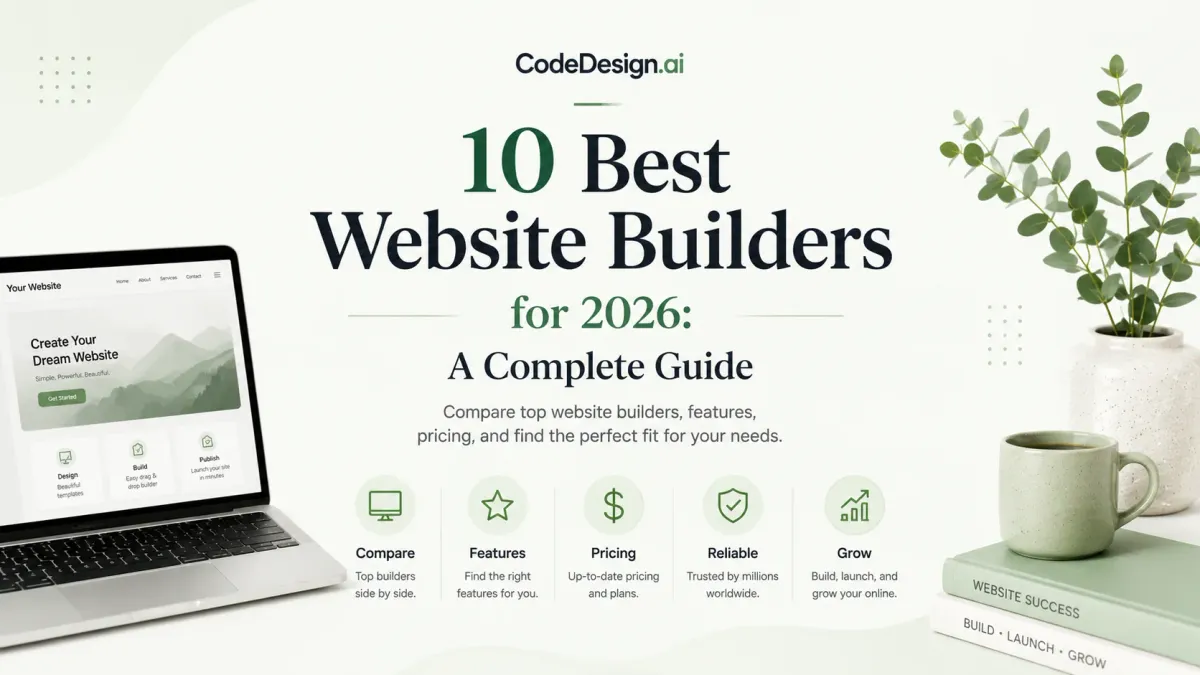
You're trying to choose a website builder before a launch date, and every option looks like it solves one problem while creating another. One platform gets you live fast but traps you in its system. Another gives you clean design control but asks for more setup than you expected. That's why the best website builder isn't the one with the loudest marketing, it's the one that fits how you work, how much control you want, and how easily you may need to move later.
The market is already moving toward builder-led websites, not custom development. AI website builder revenue is projected to rise from $2.69 billion in 2025 to $3.24 billion in 2026, and then to $17.43 billion by 2035, with an implied 20.55% CAGR according to the referenced market research roundup on Hostinger's AI website builder statistics. The same source says cloud-based tools account for about 81% of the category and SMEs generate 49% of revenue, which lines up with what buyers want in real life, less ops, more speed, and fewer moving parts.
That's the lens for this guide. Instead of pretending there's one winner, the list groups builders by what they do well, from AI-first platforms with export options to beginner-friendly all-in-ones that prioritize convenience over portability. If you're building a service site, a content brand, a store, or a landing page, you'll find a better fit by looking at ownership, editing speed, ecommerce depth, and how painful migration would be later.
Table of Contents
- 1. CodeDesign.ai
- 2. Wix
- 3. Squarespace
- 4. GoDaddy Website Builder
- 5. Webflow
- 6. Framer
- 7. Shopify
- 8. WordPress.com
- 9. Hostinger Website Builder
- 10. Carrd
- Top 10 Website Builders: Feature Comparison
- Making Your Final Choice
1. CodeDesign.ai
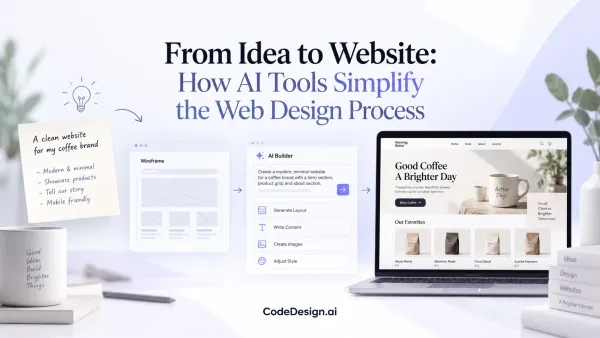
CodeDesign.ai is the strongest fit if you want AI speed without surrendering ownership. You describe the business to the agentic AI companion, or start from a template, and get a production-ready site fast, then refine it through chat, visual drag-and-drop editing, or the built-in code editor. That combination matters because it gives beginners an easy starting point and gives experienced users real room to shape the site instead of working around a closed system.
Ownership is the differentiator here. You can export clean HTML/CSS and React code, or sync directly to WordPress, which makes CodeDesign.ai feel closer to a launch platform with exit ramps than a locked box. That's a big deal for founders, agencies, and developers who don't want to rebuild from scratch if the business outgrows the original setup.
Why it stands out for real businesses
The platform also bundles the practical pieces teams usually stitch together later, including SEO audits, automated meta tags, built-in analytics without an extra tracking script, auto-backups, form handling, an AI chatbot trained on your content, appointment scheduling, and sales-funnel tools. It also supports hosting on CodeDesign's secure cloud with free SSL via Let's Encrypt, or publishing to your own domain, and the domain dashboard includes 400+ TLDs. Security and privacy are part of the pitch too, with AES-256 at rest, TLS in transit, and a stated zero-data-retention policy for user content with OpenAI integrations.
Practical rule: If you know you'll want to reuse the site, hand it off, or move it later, exportability should weigh as heavily as visual polish.
The free tier lets you build up to three projects on a CodeDesign subdomain, and the product also offers no-credit-card-required trials plus a 7-day money-back guarantee. CodeDesign says it's trusted at scale, with 4M+ sites created, around 4.8/5 ratings on Trustpilot and G2, and 400k+ makers using it. For solo entrepreneurs, agencies, SaaS teams, creators, and developers, that mix of speed, editing depth, and portability is hard to beat.
Pros
- Rapid AI-driven site creation, describe your business and get a live-ready site in seconds, then keep refining it.
- True ownership and portability, publish on CodeDesign or export clean HTML/CSS/React or sync to WordPress.
- All-in-one growth stack, with SEO audit, meta tags, analytics, backups, forms, chatbot, scheduling, and domain registration.
- Beginner-friendly and pro-capable, with natural-language AI, drag-and-drop editing, and a code editor.
- Strong social proof and security, with large-scale usage, high ratings, SSL, encryption, and a zero-data-retention stance.
Cons
- Free plan limits, only up to three projects and hosted on a CodeDesign subdomain.
- Paid-plan boundaries can be unclear, so you'll want to confirm where code export, premium support, and other advanced features sit before committing.
- Not every business needs the full stack, so very simple brochure sites may find some bundled features more than they asked for.
Website: CodeDesign.ai
2. Wix
A restaurant owner who needs online bookings, a service business that wants a polished brochure site, or a small shop that wants ecommerce without assembling five separate tools will usually find Wix easy to live with. It brings together a drag-and-drop editor, a large app marketplace, built-in ecommerce, bookings, memberships, and AI site generation through Wix AI and Harmony. That combination makes it feel less like a single tool and more like a ready-made operating setup for a small business.

The appeal is speed. You can get a site live without thinking about servers, plugins, or separate hosting decisions. The trade-off is the one that matters once a business gets serious about ownership, the site lives inside a closed platform, so portability is limited and migration is not as straightforward as it is with export-first tools.
Where Wix works best
Wix fits service businesses, appointment-based brands, and teams that want breadth without stitching together a stack on their own. The template library is broad, the editor is approachable, and Wix Studio gives agencies a more advanced path when client work needs tighter control and more room to scale within the same ecosystem.
That makes Wix a practical choice for businesses that want to start fast and improve the site in place. It is also a better fit for teams that care more about getting a professional result quickly than about owning every layer of the build.
The SEO side is usually part of that broader decision. If your site is one piece of a larger publishing strategy, this guide to how website builder SEO fits into a broader publishing strategy is a useful companion read.
The limitation is simple. Wix stays opinionated, and it does not revolve around full code export or an open workflow. If your business wants a broad feature set, quick setup, and fewer technical decisions, that is a reasonable trade. If long-term portability matters more, the closed structure becomes harder to ignore.
Pros
- Fast to publish, with templates and AI support doing a lot of the early work.
- Large app ecosystem, which helps when you need bookings, ecommerce, or marketing tools.
- Wix Studio for agencies, giving more advanced teams a stronger path than the basic builder.
Cons
- Vendor lock-in is real, since there is no full code export.
- Pricing and plan details can vary by region, so the offer you see may not match what another market sees.
- Less open than export-first builders, which can matter later if ownership becomes a priority.
Website: Wix plans
3. Squarespace
A client wants a site that looks polished on day one, without hiring a designer or managing a pile of plugins. Squarespace fits that brief. Its templates, visual editor, managed hosting, domains, and 24/7 support make it a strong all-in-one option for brand sites that need a curated or editorial feel.

The main practical advantage is low maintenance. There is no server setup to manage, no plugin stack to keep in sync, and no long list of add-ons to babysit. That matters for solo operators and small teams that want a professional site without turning web upkeep into a recurring technical task.
Squarespace also makes trade-offs that are easy to understand. The platform keeps the experience controlled, which helps consistency, but it also narrows how far you can push the build compared with more open tools. If your business values ownership and portability above all else, that closed workflow deserves attention. If your priority is a clean site that stays easy to run, the trade-off may be worth it.
Best fit for polished, low-ops sites
Squarespace works well for consultants, studios, creators, and service businesses that need strong presentation with minimal setup friction. Its commerce tools are enough for many smaller stores, and the built-in tools for domains, scheduling, and marketing keep the workflow tidy. The result is a builder that keeps the site orderly without asking for much technical oversight.
There is a real limit to how much control you get. Compared with builders aimed at developers or advanced visual customization, Squarespace gives up some depth to stay simple. That is a sensible exchange for many businesses, but it means teams that want finer control over layout, structure, or code will feel constrained sooner.
If the brand depends on visual presentation, Squarespace often feels closer to a finished showroom than a blank construction site. That is exactly why it works for businesses that want a clean, credible site with fewer moving parts.
Pros
- Consistently polished design system, with less maintenance overhead.
- Strong all-in-one stack, including domains, email, scheduling, and marketing.
- Managed hosting and support, which lowers operational friction.
Cons
- No permanent free plan, only a trial.
- Less granular customization, especially compared with Webflow or Framer.
- Not ideal for users who want deep code-level control.
Website: Squarespace pricing
4. GoDaddy Website Builder
GoDaddy Website Builder suits a business that wants the shortest route from domain to live site. It sits inside GoDaddy's wider ecosystem, so the main advantage is convenience, not depth. If a company already uses GoDaddy for domain registration and email, this builder can feel like the fastest way to get a working site online.

The Airo AI setup gives non-technical users a guided start, which helps when the priority is to launch instead of stare at a blank page. That matters for small businesses that need a live site now, even if they are not ready for fine-grained design work.
Fast setup, limited room to grow
GoDaddy makes the most sense when one provider handles the domain, email, site, and basic marketing. It can support a small store, appointment booking, forms, and standard business pages without adding much operational overhead. For a first site, that lower friction can be enough to get published without overcomplicating the process, as noted in how to publish a web site without overcomplicating the process.
The trade-off is control. The editor is narrower than what you get in Webflow or Framer, so layout and design decisions stay within a tighter frame. Ecommerce is also fairly basic, which means businesses with a larger catalog or more demanding checkout needs may outgrow it sooner than they expect.
For the right use case, that simplicity is a feature. A local service business, solo operator, or new side project often needs a site that works quickly, stays easy to manage, and does not require ongoing technical attention. GoDaddy delivers that, but it does so by keeping the ceiling relatively low.
Pros
- One vendor for core needs, which reduces setup friction for SMBs.
- Fast path for first-time sites, especially with conversational setup.
- Handles simple business pages, forms, and basic marketing without much overhead.
Cons
- Less design control than advanced visual builders.
- Ecommerce is lighter, especially compared with Shopify.
- Can feel restrictive as the business grows.
Website: GoDaddy Website Builder
5. Webflow
A team can use Webflow when the site needs to look custom, but still stay in a visual workflow. It gives designer-level control, advanced animations, a hosted CMS, and code export for handoff or headless setups, which is why agencies and startups often pick it for work that needs to feel unique instead of boxed in.

That control comes with a real learning curve, and that is part of the trade-off. Webflow exposes enough complexity to let you build properly without forcing you into a full development stack, so it suits teams that want precision and are willing to spend time on setup. Its semantic output and professional SEO structure also matter for marketing teams that care about discoverability as much as design.
Where ownership starts to matter
Webflow fits best when a site has a clear design system behind it. Agencies, SaaS teams, and startups use it for precise layout control, scalable CMS structures, and a cleaner handoff path to developers or internal teams. If you want true website ownership with fewer platform limits, the built-in export path keeps the door open, and the AI HTML website builder for code export category is worth comparing alongside it.
The trade-off is budget and effort. Pricing updates have added more moving parts, including AI credits, a new Team plan, and bandwidth add-ons on Premium, so traffic-heavy sites need closer cost planning. That makes Webflow a strong fit for serious work, but less forgiving for casual projects that just need a quick launch.
Pros
- Pixel-precise control, with advanced animations and layouts.
- Code export option, useful for handoff or headless workflows.
- Strong CMS and SEO structure, attractive for professional teams.
Cons
- Steeper learning curve than simpler builders.
- Bandwidth add-ons on Premium, which can affect high-traffic budgets.
- Less beginner-friendly, especially for solo users moving fast.
Website: Webflow pricing
6. Framer
A small team needs a site that looks polished fast, and the work still has to feel manageable inside the browser. Framer fits that brief. It is design-first, collaborative, and built for marketing sites that need strong visual direction without a full development workflow. Built-in CMS support, analytics, AI Agents, localization, and add-ons for Convert and Advanced Hosting give it enough depth for startup and agency work.

The platform's real strength is how it handles motion and component-based design. Teams can create pages that feel active and current without pushing the project into a heavier engineering process. That matters for launch pages, brand campaigns, and product sites where speed and presentation carry real weight.
Strong fit for marketing teams that test often
Framer works well for product launches, campaign pages, and websites where visual clarity supports conversion. The collaboration flow is simple to use, and the experimentation tools suit teams that revise messaging, layouts, or offers on a regular basis. It is built for motion, iteration, and quick turnaround.
The trade-off shows up in total cost. Some features, including A/B testing and advanced hosting, sit behind add-ons, and editor seats can raise the bill as more people join the project. For a lean team, that structure may still make sense, but it is not as straightforward as a flat all-in-one plan.
Framer also raises the question of ownership in a practical way. It is excellent for shipping sharp marketing pages, yet it is less about permanent infrastructure than about fast creative output. If your priority is full control over every layer of the stack, it may feel more constrained than platforms built around export or broader site ownership.
Framer works well when the site has to do two jobs at once, support the brand and push conversions. It is a strong choice for teams that care more about speed and polish than backend complexity.
Pros
- Fast to design premium marketing pages, with modern animations.
- Built-in experimentation and localization, useful for growth teams.
- Live collaboration, which helps agencies and startups move quickly.
Cons
- A/B testing and advanced hosting are add-ons.
- Costs can rise with bandwidth and collaborators.
- Less suited to complex, content-heavy sites.
Website: Framer sites
7. Shopify
A clothing brand that needs reliable checkout, a clean product catalog, and room to add sales channels will usually look at Shopify first. It is built for selling, with a website builder, hosted checkout, POS, a large app and theme ecosystem, and the Sidekick AI assistant all working around the same core job. For a store, that setup is practical.

The core value is in the commerce stack. Checkout, payments, inventory, and multichannel selling sit inside the platform, so you are not stitching store operations together from separate tools. If your priority is dependable selling rather than broad design freedom, Shopify makes that trade-off clear.
A store platform that keeps commerce at the center
Shopify works for small MVP stores and can grow into enterprise and B2B use cases through Shopify Plus. That gives product businesses a path forward without jumping to a new platform every time the store gets more complex. It also keeps the merchant logic in one place while themes and apps handle the front end and added features.
There is a cost to that focus. For editorial sites, brand-first pages, or businesses that do not sell as their main job, Shopify can feel heavier than a general-purpose builder. It can handle those needs, but the store system remains the center of gravity.
If your site needs commerce plus a payment setup that fits real product operations, the payment workflow for builders that also sell is easier to justify here than on a general site builder.
Pros
- Strong commerce infrastructure, especially for checkout and payments.
- Large app and theme marketplace, which adds features quickly.
- Grows from small stores to enterprise, including B2B use cases.
Cons
- Less flexible for sites that are not commerce-first.
- Pricing and promotions vary by region.
- App costs can stack up over time.
Website: Shopify pricing
8. WordPress.com
WordPress.com gives you the WordPress ecosystem without making you manage the full stack yourself. Managed updates, security, CDN, plugins on paid plans, and developer tooling on higher tiers come built in. For content-heavy businesses, that mix keeps the site flexible without forcing constant infrastructure work.

The primary advantage is ownership within a managed setup. If content strategy matters and you want room to expand into more advanced workflows later, WordPress.com gives you a practical bridge between convenience and depth. It is not as barebones as a no-code builder, and that is part of the trade-off. You get more structure up front, which matters when the site needs to grow without being rebuilt from scratch.
Good for content brands that need room to grow
WordPress.com works well for blogs, media-style sites, and businesses that publish often. The block editor is modern, the theme and plugin ecosystem is huge, and higher tiers add developer tooling like SFTP, SSH, WP-CLI, and Git deployments. That gives teams a path from simple publishing to more technical work without leaving the WordPress ecosystem.
The trade-off is complexity. Even in a managed environment, plugins and updates still need judgment, especially if the site depends on several extensions working together. For many teams that is manageable, but it is still more involved than an all-in-one visual builder, where the platform handles more of the setup for you. If you care about reducing vendor lock-in while keeping a familiar publishing workflow, WordPress.com sits in a useful middle ground.
If your website is going to become a content engine, WordPress.com gives you a familiar structure and a lot of future options.
Pros
- Vast WordPress ecosystem, with strong portability within the platform family.
- Good for blogs and content sites, and can scale to ecommerce through WooCommerce.
- Managed updates and CDN, which reduces operational work.
Cons
- More moving parts than pure no-code builders.
- Plugins still need oversight, even in a managed setup.
- Less beginner-simple than some drag-and-drop options.
Website: WordPress.com pricing
9. Hostinger Website Builder
A small business owner who needs a site live quickly can get a lot from Hostinger Website Builder. It bundles hosting, domains, and marketing tools in one place, and the editor adds AI help for copy, image, logo, and SEO tasks. That keeps the setup simple for buyers who want one bill and one workflow instead of stitching together separate services.

The fit is clear: it works well for straightforward sites that need to look professional without demanding much technical effort. The trade-off is depth. Hostinger gives you speed and value, but it does not aim for the same level of customization or control you get from more advanced builders.
Best for budget-conscious small businesses
For local services, solo operators, and smaller stores, Hostinger keeps the launch process manageable. The template library gives you a quick starting point, the editor is easy to learn, and the bundled hosting reduces the amount of setup work. That makes it easier to move from idea to live site without spending time on separate technical decisions.
The ecommerce side is lighter than Shopify, so stores with larger catalogs or more complex sales workflows may outgrow it sooner. That is the main business trade-off. You get lower friction and a simpler purchase, but you give up some room to expand into advanced commerce features.
Pricing deserves a careful look before you commit. Hostinger's terms can vary by region and plan length, especially around promotional rates, so the renewal structure matters as much as the introductory offer. Buyers who value clarity and a lower starting cost will find that useful, while buyers who expect to scale fast should compare the long-term fit with a more specialized platform.
Pros
- Competitive introductory value, especially for small businesses that want to keep setup costs down.
- AI-assisted setup, which helps with copy, images, logos, and SEO.
- Bundled hosting and domains, which reduces the number of separate services to manage.
Cons
- Pricing can vary by region and term.
- Ecommerce depth is lighter than a dedicated commerce platform.
- Less suited to advanced customization.
Website: Hostinger Website Builder
10. Carrd
A single-page site is where Carrd makes the most sense. Link-in-bio pages, personal profiles, lead capture pages, and lightweight microsites are the work it was built for, and the setup stays fast because the product stays narrow. That narrow focus is the trade-off, and it is also the reason many solo creators keep using it.

For a solo founder or creator, Carrd often handles the simplest website need more cleanly than a larger platform. If the goal is to send traffic somewhere credible without spending time on a heavy dashboard, Carrd stays out of the way and gets the page live.
Best for microsites and quick launches
Carrd's Pro tiers support custom domains, forms, embeds, and code injection, and Pro Plus includes an option to download the site source. That gives you a useful amount of control for lightweight projects, while keeping the editor and publishing flow straightforward. For buyers who care about ownership, the source download option matters because it gives you a path away from full platform dependence.
For readers comparing free entry points across smaller builders, this guide to portfolio website builder options for free starters is a useful companion. Carrd still stands apart because it asks less of you from the start.
Large multi-page sites and complex ecommerce sit outside Carrd's sweet spot. That is a deliberate product boundary, not a flaw. The platform is meant to do one job well, and it does that job with very little setup.
Use Carrd when the website is a landing pad, not the whole business.
Pros
- Very low total cost to launch, especially for a professional single-page site.
- Simple editing and fast hosting, with SSL included.
- Source download option, useful for users who want more flexibility.
Cons
- Not intended for large or complex sites.
- Feature set is intentionally minimal.
- Not a commerce platform.
Internal reading for one-page portfolio workflows: portfolio website builder options for free starters
Website: Carrd Pro plans
Top 10 Website Builders: Feature Comparison
| Platform | Core features | UX & Quality | Value / Pricing | Target audience | Unique selling points |
|---|---|---|---|---|---|
| CodeDesign.ai 🏆 | ✨ AI site generator, drag‑drop & code editor, export HTML/CSS/React, hosting, SEO, forms | ★4.8 · Fast generation · Built‑in analytics & backups · AES‑256/TLS | 💰 Generous free tier (3 projects) + paid plans; annual discounts & 7‑day refund | 👥 Solo founders, creators, agencies, developers | ✨ Exportable code, WordPress sync, AI companion, 400+ TLDs |
| Wix | AI site generator, drag‑drop editor, app marketplace, ecommerce | ★★★★★ · Many templates · Easy to publish | 💰 Free trial; tiered paid plans with apps | 👥 Beginners, small businesses, agencies (Wix Studio) | ✨ Large app ecosystem & built‑in commerce/bookings |
| Squarespace | Design‑forward templates, managed hosting, ecommerce, blogging | ★★★★ · Polished visuals · 24/7 support | 💰 Trial only; paid plans (no permanent free) | 👥 Creatives, portfolios, small stores | ✨ Award‑winning templates & low maintenance |
| GoDaddy Website Builder | Templates, forms, SEO, appointments, optional store, Airo AI | ★★★★ · Simple editor · Fast setup | 💰 Promotional pricing; domain + hosting bundles | 👥 SMBs needing one‑vendor convenience | ✨ Domain/hosting/email integration & promos |
| Webflow | Visual CSS control, interactions, hosted CMS, code export | ★★★★ · Pixel‑precise · Professional SEO output | 💰 Paid tiers; code export & bandwidth considerations | 👥 Designers, agencies, startups | ✨ Advanced layout control + code export for handoff |
| Framer | Design‑centric editor, CMS, analytics, AI Agents, collaboration | ★★★★ · Modern animations · Fast prototyping | 💰 Free → Pro/Enterprise; per‑editor pricing | 👥 Startups, agencies, marketing teams | ✨ Built‑in A/B testing (Convert), localization, collaboration |
| Shopify | Ecommerce‑first builder, hosted checkout, POS, app/theme store | ★★★★★ · Best‑in‑class commerce UX · Scales to enterprise | 💰 Tiered commerce plans; Shopify Plus for enterprise | 👥 Merchants, growing ecommerce brands | ✨ Checkout, POS, vast app & payments ecosystem |
| WordPress.com | Hosted WordPress, block editor, plugins on paid plans, CDN | ★★★★ · Flexible ecosystem · Managed updates/security | 💰 Free tier; paid plans unlock plugins & dev tools | 👥 Content publishers, blogs, scalable sites | ✨ Plugin ecosystem + WooCommerce scale potential |
| Hostinger Website Builder | Drag‑drop editor, AI copy/image tools, SSL, email, domain | ★★★★ · Affordable & fast setup | 💰 Very competitive promos; bundled hosting value | 👥 Price‑sensitive SMBs & hobbyists | ✨ Strong introductory pricing + hosting bundle |
| Carrd | Ultra‑simple one‑page builder, forms, code injection (Pro) | ★★★★ · Extremely fast & reliable | 💰 Very low cost; 3 Pro tiers | 👥 Personal pages, landing pages, MVPs | ✨ Lowest cost single‑page launch; very simple UX |
Making Your Final Choice
The best website builder is the one that matches your next 12 months, not the one that looks impressive in a screenshot. If you need maximum convenience, builders like Wix, Squarespace, GoDaddy, and Hostinger make setup easier. If you need design precision, Webflow and Framer push much further. If you need commerce, Shopify is the obvious specialist. If you need content infrastructure, WordPress.com stays relevant. If you only need a one-page presence, Carrd keeps the project lean.
The biggest decision is ownership versus convenience. That gap shows up the moment a business wants to move, reuse, or expand a site. PCMag's roundup of the market makes the same point indirectly, reviews often focus on usability and templates, but the question is what happens when you need portability or a different workflow later. That's why exportability and migration flexibility should sit near the top of the list, not at the end.
The second question is current needs versus future scale. A service business launching today may only need a few pages and a contact form, but a year later it may want bookings, a blog, lead magnets, or ecommerce. The right builder should either grow with that plan or make moving up painless. That's where platforms with strong code export or broader ecosystem access deserve extra attention.
The third question is speed versus control. AI-assisted builders win when a founder needs a site live fast and doesn't want to wrestle with layout details. Design-led builders win when the brand needs precise art direction or conversion testing. Both approaches work, but they solve different problems. Independent review sites keep circling back to the same buyer factors, site purpose, technical skill level, and design-control needs, because those really do determine success more than any generic “best” label.
For most solo entrepreneurs and small businesses, CodeDesign.ai lands in a useful middle ground. It gives you AI generation, visual editing, code export, WordPress sync, hosting, SEO tools, and business automation in one place, so you're not forced to choose between moving fast and keeping your options open. That balance is what makes it one of the most practical choices in a crowded market.
If you want a builder that helps you launch quickly without locking you in, CodeDesign.ai is built for that exact problem. You can generate a site with AI, refine it visually or with code, and keep the option to export or publish where you want. Visit it now if you want a platform that treats speed, ownership, and conversion as part of the same workflow.