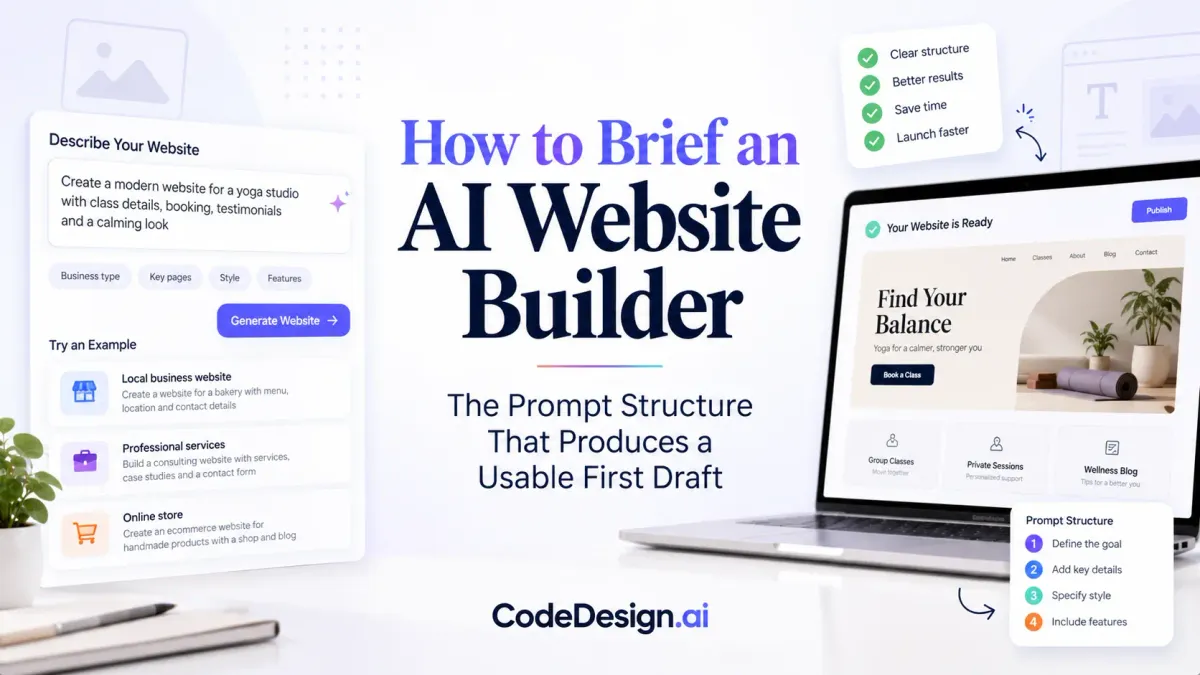
How to Brief an AI Website Builder: The Prompt Structure That Produces a Usable First Draft
The difference between a generated site you can ship and one you delete is almost never the tool. It is brief.
Type "make me a website for my bakery" and you will get a bakery website: warm colours, a hero image of bread, a section about passion for quality ingredients, and a contact form. It will be competent, it will look like every other bakery site, and it will contain nothing that could only be true of your bakery.
That is not a failure of the model. It is a failure of specification. You asked for a category and received the statistical centre of that category, which is exactly what you requested.
Why Vague Prompts Produce Average Sites
A generative model completes patterns. When your prompt underdetermines something, the model does not stop and ask. It fills the gap with the most probable answer given everything it has seen.
Every gap you leave is therefore filled with the average of your industry. Ask for a consultancy site without specifying the audience, and you get copy addressed to everyone, which reads as addressed to nobody. Omit your pricing and you get a call to action inviting visitors to learn more, because that is what pages say when they have nothing specific to offer.
This is the single most useful mental model available here. Whatever you do not specify, you are delegating to the average. Sometimes that is fine: you probably do not care which of four standard testimonial layouts appears. Often it is not, because the parts you left unspecified are usually the parts that would have differentiated you.
The corollary is practical. A longer prompt is not automatically better. A more specific one is. Three hundred words of adjectives will produce worse output than eighty words of concrete facts, and people routinely write the former because it feels like effort.
You Are Writing a Brief, Not a Wish
The most reliable way to improve your prompt is to imagine handing it to a competent freelance designer and asking what they would need to know before starting.
They would not ask what colours you like first. They would ask what the business does, who buys from it, what you want a visitor to do, and what evidence exists that you are any good. Then they would ask how many pages and what goes on each.
Those questions map exactly onto what a generator needs, and for the same reason: without them, both a designer and a model are guessing. The designer would tell you they are guessing. The model will not, and it will present its guesses in finished layouts that look decided rather than assumed.
The Five Parts of a Working Brief
Every effective brief I have seen contains these, roughly in this order.
One: the business, concretely. Not the category, the specifics. Not a bakery, but a sourdough micro-bakery in one neighbourhood that sells out by eleven and takes weekly subscriptions. The distinguishing facts are what prevent generic output.
Two: the audience, narrowly. Name one type of customer, not four. Broad addressing produces broad copy, and specificity in the brief propagates into specificity in the headline. Writing for one person outperforms writing for a market, and this is true of models for the same reasons it is true of humans.
Three: the single action. What is the one thing a visitor should do? Book, buy, subscribe, call, request a quote. Naming one primary action is what allows the generator to build a page with a spine rather than a page with six equally weighted options.
Four: the proof you actually have. Years operating, number of clients, a real testimonial, a certification, named companies you have worked with, a metric you can defend. This is the highest-leverage element in the entire brief, because credibility is the thing a model cannot invent for you and will otherwise fill with hollow phrasing. Trusted by businesses nationwide is what a page says when nobody told it anything real.
Five: the constraints. Tone in plain terms, words to avoid, anything the site must not say. Constraints are underused and disproportionately effective, because telling a model what to avoid is often more precise than telling it what to do. If you never want the phrase cutting edge to appear on your site, say so once and it will not.
What to Leave Out
Some common inclusions make the result worse.
Competitor names as style references. Asking for something like a well-known brand's site produces a diluted imitation without that brand's assets, photography or budget. Describe the property you actually want instead.
Everything at once. A prompt attempting eight pages, full copy, brand guidelines and an integration plan produces a shallow version of all of it. Generate the structure and the home page first, then extend.
Fictional placeholder content. Inventing testimonials or statistics for the first draft is tempting and it corrupts everything downstream, because you will later have to remove copy that the layout was built around. Say you have no testimonials yet. A good brief admits its gaps.
A Worked Example
Weak: "Create a professional, modern website for my accounting firm. Clean design, easy to navigate, mobile friendly."
Everything there is either default behaviour or an adjective. Mobile friendly is not a request, it is table stakes.
Stronger: "A four-page site for a two-person accounting practice in Leeds working exclusively with UK freelancers and sole traders earning under eighty thousand a year. Primary action: book a free twenty-minute call. We have been operating nine years, have around two hundred active clients, and are ACCA qualified. Pages: home, services with three fixed-price packages, about with both partners, contact. Home page sections in order: hero with the booking call to action, the three packages with prices, a short section on how the onboarding works, two testimonials, an FAQ covering switching accountants. Tone: plain and direct. Avoid corporate language and any mention of bespoke solutions."
The second prompt is not decorated. It contains facts, an audience, an action, evidence, a structure and a constraint. What comes back is editable rather than replaceable.
The Second Prompt Matters More Than the First
Most of the value in these tools is in revision, and revision is where most people lose control of the output.
Change one thing at a time. Bundled requests produce drift in areas you did not ask about, and when four things change simultaneously you cannot tell which instruction caused which effect.
Name the location precisely. Refer to the third section on the home page, or the pricing table, rather than saying the middle bit. Ambiguous references get resolved by guessing.
Describe the outcome, not the implementation. Asking to make the pricing easier to compare gives the system room to solve the problem properly. Asking for a specific column width solves your hypothesis about the problem instead.
Keep what works. When something is right, say so and mark it as fixed. Some builders honour that instruction and most people never give it.
Go back rather than forward when a revision makes things worse. Three corrective prompts stacked on a bad change usually produce something further from what you wanted than reverting and re-asking once, clearly.
Whether you are using a free AI website generator or a paid platform with unlimited regeneration, this revision discipline determines the outcome more than any capability difference between the tools. ImagineArt's builder, like most of the serious ones, responds far better to a specific instruction about one section than to a request to try again.
The Sixty-Second Test for a Brief
Before you generate anything, read your brief back and ask one question: could a direct competitor have written this?
If the answer is yes, it is not a brief. It is a category description, and it will produce a category-average site. Every sentence that a competitor could also have written is a sentence contributing nothing.
The fix is mechanical. Go through line by line and replace each general claim with something that is verifiably true only of you. Quality ingredients becomes flour milled twelve miles away. Excellent customer service becomes we answer every email within four hours, including Saturdays. Experienced team becomes nine years and two hundred clients.
This single pass usually improves output more than any other change you can make, because specificity is the one input a model genuinely cannot supply on your behalf.
What No Brief Can Fix
Being clear about the ceiling is more useful than pretending there isn't one.
A brief cannot supply positioning. If you have not decided what makes you the right choice, no prompt structure will decide it for you, and the generated page will hedge because you hedged.
It cannot manufacture proof. If you have no clients, no numbers and no testimonials, the site will be thin, and the correct fix is to go and get one customer rather than to rewrite the prompt.
It cannot fix an offer nobody wants. A clear site that presents an unattractive proposition converts worse than a messy site presenting a compelling one, because it communicates the problem more efficiently.
These are strategy problems wearing the costume of design problems, and they are the most common reason a technically fine site produces nothing. No amount of prompt engineering substitutes for talking to three customers about why they chose you.
A Template You Can Reuse With Any Free AI Website Generator
Business: what you do, concretely, including the details that are true only of you.
Audience: one named customer type.
Primary action: the single thing a visitor should do.
Proof: real numbers, credentials, clients, testimonials.
Pages: the list.
Home sections: in order.
Tone: plain description.
Avoid: words and claims to exclude.
Eight lines. Fill them in before you open any builder, and keep the filled version somewhere permanent, because you will reuse it for landing pages, ad copy, your next site and every brief you write after this one. The brief is the reusable asset. The output is disposable, and treating it the other way round is why most people start from scratch every time.
Tools built around a single project context, such as Imagine AI, make that reuse easier, since the brief informs everything produced afterwards rather than being retyped into each new tool.
The Bottom Line
The quality of a generated site is set before generation begins. Models are now good enough that the constraint has moved upstream, from what the tool can produce to what you told it.
Spend fifteen minutes on the brief before you open anything. Write facts rather than adjectives, name one audience and one action, include the proof you actually have, and decide the structure yourself. Then revise one thing at a time, naming the section you mean.
The output stops being a starting point you tolerate and becomes a draft you actually want to edit, and that is the whole difference between a site you ship and one you abandon.