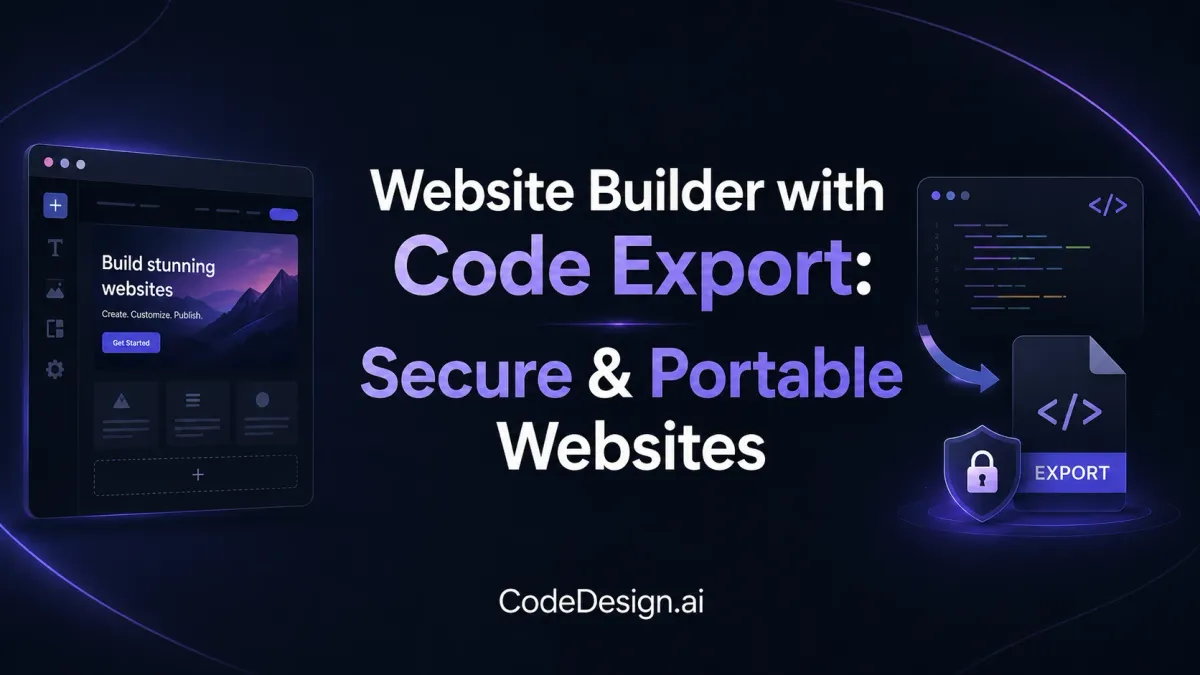
Website Builder with Code Export: Secure & Portable Websites
You usually notice the problem after the launch rush is over. The site looks fine, the lead form works, and the client is happy, until someone asks for a redesign, a migration, or a handoff to a developer, and the answer turns into a headache because the builder won't let the project leave.
That's where a website builder with code export changes the conversation. Instead of treating the site like something you rent inside one platform forever, exportable builders give you a path to own the files, move the project, and keep building without starting from zero. For solo founders, agencies, and small teams, that difference shows up later in lower lock-in, simpler handoffs, and far less panic when a platform stops fitting the business. For a broader view of the no-code environment, the basics in this no-code guide help frame why export matters in the first place.
Table of Contents
- Introduction to Code Export Portability
- Understanding Code Export Website Builders
- Analyzing Benefits and Trade Offs
- Comparing Common Export Formats
- Running the Export Workflow
- Security and Maintenance After Export
- Choosing the Right Builder for Your Business
- Showcasing CodeDesign.ai Export Features and Next Steps
Introduction to Code Export Portability
A lot of people discover portability too late. They build a site on a closed platform, add custom pages, refine the layout, connect forms, and months later realize the project cannot move to another host or developer stack without being rebuilt. At that point, each small change starts to feel expensive because the original builder controls the runtime, the deployment path, and often the future edits too.
That is why code export matters beyond convenience. It gives you a path out of the platform when hosting, support, or product direction changes, and it keeps your work closer to assets you can move and maintain. The clearest way to understand that idea is the same distinction people make in what no-code means in practice, where the core question is how much control the builder leaves in your hands after the initial build.
The practical value shows up after launch, not just during design. Agencies need to hand off sites to developers. Founders need hosting flexibility. Small businesses need a way out if pricing, features, or support change later. Exportable builders do not remove every risk, but they reduce the biggest one, getting trapped in a system you cannot leave.
A good website builder with code export gives you a working site today and a migration path tomorrow. That matters because exported files still need security checks, dependency updates, and a place to deploy. The promise is not only that you can download code, it is that you can keep using that code when your setup, team, or hosting needs change.
Understanding Code Export Website Builders

A code-export builder begins like a standard visual editor. You drag blocks into place, adjust sections, or let AI draft a first version. The difference appears under the hood. The builder does not only render a page inside its own system, it also produces source files you can move to another environment.
Those files usually include HTML, CSS, JavaScript, plus assets such as images and fonts. In practice, you are not buying a locked room, you are getting a project folder you can carry elsewhere. That matters because export is still uneven across the market, as the infographic above shows, so it is a capability to check carefully rather than assume. For a product-level example of how export can sit inside a visual workflow, CodeDesign.ai's features page shows one way builders present that mix.
What code export really changes
The main shift is control after the build. Many no-code tools keep pages inside a proprietary runtime, which leaves the platform in charge of hosting and future movement. Exportable tools let you work in the editor, then hand the finished files to a host, a Git repo, or a developer.
Practical rule: if the builder gives you files you can open, edit, and deploy elsewhere, you are dealing with ownership, not just convenience.
That is why teams treat code export as a planning decision, not a checkbox. A builder may include export in the core workflow or hide it behind a higher plan. Once the files leave the editor, significant effort begins. You still need a place to deploy them, a process for updates, and someone who can maintain the code when the site changes.
Exportable builders matter most when the post-launch reality changes. Hosting can move. Support can shift. A client may need a handoff to another developer. The exported code gives you a path through those changes, but it also asks you to manage security checks, dependency updates, and deployment more deliberately.
Analyzing Benefits and Trade Offs
Code export solves a real problem, but it doesn't solve everything. The upside is obvious if you've ever had to leave a platform that no longer fits your workflow. You can move the project, keep the code, and avoid rebuilding every page by hand.
The main benefits
Ownership is the first one. Once you export the project, the code lives outside the builder's walls, which reduces vendor risk and gives your team something concrete to maintain. Hosting flexibility comes next, since exported files can go to different environments depending on whether the site is static, server-rendered, or part of a larger stack.
Developer handoff is another major win. A designer can build fast in a visual editor, export the project, and let a developer continue from there instead of redrawing everything from scratch. That's especially useful for agencies that need a repeatable process across client work.
The trade offs you shouldn't ignore
Export also adds responsibility. A managed builder may handle updates, backups, and some content workflows for you, but exported code usually moves those tasks onto your side. If the site depends on forms, CMS content, or analytics, those pieces may need extra setup after export.
One more thing matters here. A builder can export code and still leave you with a project that needs basic frontend knowledge to maintain. That's not a flaw, it's the price of portability.
Export is worth it when control matters more than convenience. If your team wants the fastest path to a page and doesn't care about future migration, a fully managed platform can still be the simpler choice.
The strongest use case is a business that wants speed now and options later. That's why export sits in the middle ground between pure no-code convenience and full developer ownership.
Comparing Common Export Formats

Not all exports behave the same way. Some builders give you a static bundle that's easy to host anywhere. Others export framework-native projects that fit into modern development workflows and let a team keep iterating with components instead of flat pages.
Static bundles
Static HTML/CSS/JS exports are usually the easiest to understand. They're a good fit for landing pages, portfolios, simple business sites, and other pages that don't need a heavy app layer. The code is often straightforward to inspect and edit, which makes it friendlier for smaller teams or quick handoffs.
Framework-native exports
Framework exports are a different story. TeleportHQ, for example, supports export to React, Next.js, Gatsby, Vue, Nuxt, Angular, Preact, and plain HTML/CSS TeleportHQ review. That kind of output makes the same design portable across static hosting, server-rendered workflows, and SPA-style builds.
Developer note: the more framework-native the export, the more you should think about component structure, build tooling, and ongoing maintenance before you publish.
For more detail on how form-based builders fit into exportable workflows, the examples in this HTML form builder guide help show where simple static output ends and more interactive project structure begins.
How to choose
A static bundle is usually enough for marketing pages and brochure sites. A framework export makes more sense when the site needs reuse, shared components, or a future path into a larger application. The important part isn't which format sounds more advanced, it's which one matches the practical nature of the project you're planning to maintain.
Running the Export Workflow

The workflow usually feels simple until you need the files in production. You pick templates, configure assets, generate the bundle, and download a ZIP, but the useful part is understanding what each step means for the final site. A clean export saves time later because the folder structure, asset paths, and deployment assumptions are already in place.
Step 1 Select the pages you actually need
Most builders let you start from templates or individual pages. That matters because you don't always want to export the entire project at once. A brochure site might only need a handful of pages, while a dashboard-style build may need a more structured export with reusable pieces.
Step 2 Check assets before the bundle is generated
Images, fonts, and media files can make or break portability. If the export doesn't include them cleanly, the site may look broken after you move it. That's why asset settings matter more than beginners expect.
Step 3 Generate the code package
This is the point where the builder compiles the design into source files. In some tools, the output is a ZIP archive with folders for code, styles, and assets. In others, the export is tied to a framework project that can be pushed into a Git workflow.
Step 4 Move it into your deployment path
One user on r/webdev described exporting from CodeDesign.ai in a Google Takeout-style ZIP and deploying to GitHub and Netlify in minutes r/webdev example. That kind of handoff is a significant test of export quality, because the files have to survive outside the builder and still run cleanly on the host you choose.
For a publishing-oriented view of deployment, this publishing guide is a useful companion if you're mapping export to live hosting. You can also watch a practical workflow in the video below.
A lot of teams stop after the download button. The better habit is to test the exported site in a clean environment, because that's where broken links, missing assets, and path issues show up before your visitors do.
Security and Maintenance After Export
Exporting a site doesn't end your responsibility, it changes it. Once the project leaves the original platform, you or your developer team own the updates, the hosting setup, and the risk surface. If you're moving to self-hosted infrastructure, you also need to think about SSL, dependency updates, backups, and how future edits will happen.
What usually gets overlooked
Many comparisons stop at file download, but a core challenge is preserving forms, CMS features, and analytics once a site leaves its original platform Webstudio's export discussion. That's the part teams miss when they assume the exported code is the whole job. A site can be portable and still lose important behavior if those systems aren't recreated properly.
The maintenance habits that matter
Keep the exported project in version control so changes are traceable. Run security checks on dependencies if the export includes a framework or package ecosystem. Back up the project before every major edit, because once the files are in your environment, recovery becomes your own job, not the platform's.
Content updates need a plan too. If the original builder handled CMS entries, someone has to decide where those entries live after export and who edits them. The same goes for tracking scripts, SEO metadata, and form routing.
If a builder makes export easy, treat the exported site like production software, not a one-time download.
That mindset keeps the project stable after launch. It also protects the main reason people wanted export in the first place, the freedom to move without losing control.
Choosing the Right Builder for Your Business
The right tool depends on what your business needs after launch, not just on how fast it can produce the first page. Some teams need a clean marketing site they can host anywhere. Others need a project that a developer can extend without rewriting the layout. A few need a builder that can support both visual editing and a more structured code handoff.
Match the export to the business model
Agencies should look for export formats that make client handoff easy, because the handoff is often where time gets lost. Solo founders usually need the balance point between speed and control, with enough export freedom to avoid lock-in but not so much complexity that maintenance becomes a burden. SaaS teams often benefit from framework-native output because reusable components and developer workflows matter more as the product grows.
What to check before you commit
- Export format support: Make sure the builder exports in a format your team can deploy and maintain.
- Hosting options: Check whether the output works on static hosts, app hosts, or both.
- CMS portability: Confirm what happens to blog content, forms, and dynamic sections after export.
- Security model: Look at SSL, backups, and how the project is protected once it leaves the builder.
- Workflow fit: Decide whether your team wants a designer-first editor, a developer-friendly structure, or a blend of both.
A helpful way to think about it is this. If you want to publish fast and never touch the code again, a closed platform might be enough. If you want a site that can grow, move, and survive team changes, export is the feature that protects that future.
That's why some teams compare builders on launch speed, while smarter teams compare them on what happens six months later.
Showcasing CodeDesign.ai Export Features and Next Steps

Some builders make you choose between speed and ownership. CodeDesign.ai combines both by offering over 5,000 responsive templates, full code export to HTML and React, and CMS sync to WordPress CodeDesign.ai's export and template coverage. That mix matters because it lets a team start visually, keep the output portable, and still connect the site to a content workflow when needed.
The editor is built for a quick first draft, then refinement. You can generate pages, adjust the design, and export the result as production-ready code rather than a locked page inside one platform. For a deeper look at the export-focused builder path, this AI HTML export page shows how the workflow fits a code-first handoff.
If you're testing the idea for the first time, the sensible move is simple. Start with a small site, export it, inspect the files, and deploy it somewhere you control. That tells you more than any feature list can, because you'll see whether the builder gives you a project you can own.
A website builder with code export should make your next move easier, not harder. If you want to try that approach in a practical way, go to CodeDesign.ai, generate a site, export the code, and test the handoff on your own hosting stack.