Why AI Website Builders Are Perfect for Non-Technical Users
There was a time when building a website required web developers to do the coding, web designers to create the layout, and a handful of applications that the team required. The code, structure, design systems, and everything else in between used to feel out of reach for ordinary people.

However, it is not like that anymore, thanks to artificial intelligence. What required a lot of engineering now only needs clever prompting, and even without technical training, anyone can do it.
Instead of writing lines of code, users answer a few questions, describe what they want, and watch a full site take shape in minutes, and this changes the capacity of what they can do. Here are a few reasons why AI website creators are perfect for people who have never written one line of code.
No Coding Needed
AI website builders remove the single biggest barrier for beginners, which is coding, so instead of dealing with HTML, CSS, or JavaScript, users interact with prompts that feel more like instructions than technical tasks.
You describe your business, your audience, and your style preferences, and the system translates that into a working website. Non-technical users don’t struggle with ideas; they struggle with execution, and AI can eliminate this instantly.
Even tasks like structuring pages, choosing fonts, or organizing content are handled automatically with such tools, so all you need to bring is your ideas and nothing else.
Create Websites in Minutes
Speed is where AI website builders feel almost unreal, because while traditional website development can take days or weeks, even for simple projects, AI compresses that entire process into minutes.
You answer a few guided questions, select a theme or tone, and the system generates a complete website, including layout, content blocks, navigation, and basic styling.
What once required multiple tools and steps now happens in a single flow, and for non-technical users, this speed removes friction. There is no long waiting period, no need to coordinate with designers or developers, and you can go from idea to live site in one sitting.
This also encourages experimentation, which means if a user does not like the first version, they can regenerate or adjust it without starting from scratch. This makes the process flexible rather than fixed, which is important for beginners still figuring out their direction.
Get Content for the Websites in Minutes
One of the best parts about an AI website builder is how they handle both design and content. Traditionally, these are separate processes, and you design a layout first, then try to fill it with content, which often leads to awkward spacing or mismatched sections.
AI approaches this differently, as it builds design and content at the same time, ensuring they fit naturally.
Headlines, paragraphs, images, and sections are placed with context in mind, and the result feels cohesive from the start, removing guesswork for non-technical users. They do not have to wonder where to place a call-to-action or how much text belongs in a section, as the system makes those decisions based on patterns that work.
This also reduces the blank page problem, and instead of staring at an empty editor, users start with something complete. From there, they can refine rather than create from scratch, which makes the process less overwhelming and more manageable.
However, it is advisable to use a plagiarism checker for the content created by an AI website creator, as it is generated based on patterns, which can make your website content very similar to another created using the same tool.
Edit Without Worry
Editing a website used to come with risk, as one wrong change in code could break the layout or functionality, but AI website builders eliminate that risk by offering controlled, visual editing environments.
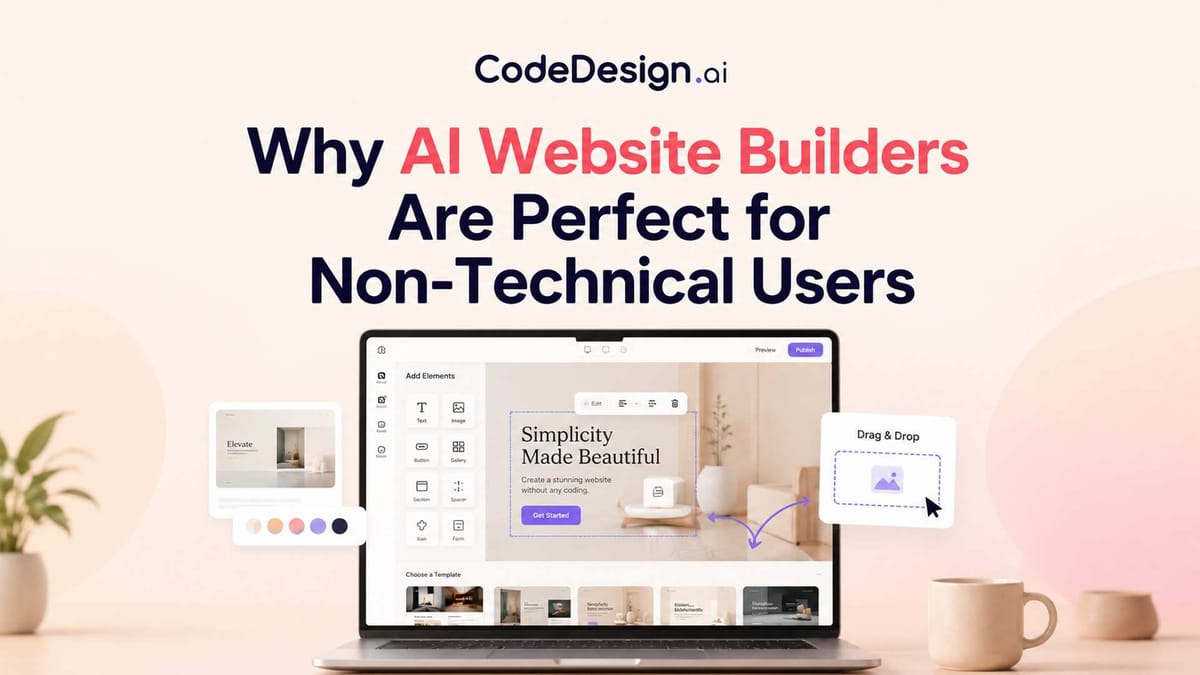
Most platforms use drag-and-drop systems combined with smart suggestions, and you can move sections, change text, swap images, and adjust styles without affecting the underlying structure.
Since everything updates in real time, you see exactly what you are doing, which creates a sense of safety for non-technical users. You can experiment without worrying about damaging the site you have created, as the system maintains consistency behind the scenes. This is especially beneficial for financial service providers, where websites often require frequent updates and a seamless customer experience.
This also speeds up learning, as instead of studying tutorials or documentation, users learn by doing, and the interface guides them naturally, and small changes build confidence over time.
Built-In Features Take Away Added Work
A website requires a lot of things, including forms, search engine optimization, mobile responsiveness, and other tools that need to be integrated. These features need subscription to external services, manual setup, and plugins.
The good thing about AI builders is that it generally comes with these features. For example, you have contact forms, mobile optimization, and basic SEO built in, without needing to know more.
For non-technical users, this removes any complexity, and you don’t need to learn how to install or configure these tools, as all the essentials are already available in the platform.
This also removes dependency on third-party applications, and instead of having to juggle multiple subscriptions, you get everything in one platform. This way, the one creating the website can keep their focus on the important stuff, rather than the tools.
Cost-Effective Without Sacrificing Quality
Hiring a developer or agency can be expensive, especially for small businesses or individuals just starting out, which is why AI website builders offer a more accessible alternative.
Many platforms provide affordable plans or even free tiers that include core features, which allow users to launch a website without a large upfront investment. For non-technical users, this lowers the risk of getting started.
What makes this more compelling is that the quality does not feel compromised, as the AI-generated designs are modern, clean, and functional. The platforms follow current design standards, which means users do not have to worry about outdated layouts.
This balance between cost and quality makes AI builders practical, as you get a professional-looking result without the traditional price tag.
The Platform Guides You
AI website builders are designed to guide users step by step, which means that instead of dealing with a complex dashboard, they walk you through the process in a structured way.
You start with basic questions about your site’s purpose, and then you move to style preferences, content tone, features, etc, and each step builds on the previous one, creating a clear path forward.
For non-technical users, this guidance reduces confusion, as you are not left wondering what to do next, and the system leads you through the process without overwhelming you.
This creates a sense of progress, with each step feeling like a small win, which keeps users engaged, and by the time the site is generated, the process feels smooth rather than complicated.
AI Builders are Flexible
While AI website builders are known for speed, they are not limited to quick setup, as they also allow for ongoing changes and updates.
As a business grows, the website can evolve with it; therefore, new sections can be added, content can be updated, and designs can be refreshed without rebuilding everything.
AI tools often suggest improvements based on user behavior or trends, making updates easier, and for non-technical users, this flexibility is important, as it means the website is not a one-time project.
The website then becomes something that can adapt over time without requiring technical intervention, which keeps the costs low, as instead of having to hire help for every change, the user can handle the updates on their own.
AI is Not Perfect
AI website builders are powerful, but they are not perfect. Fine-tuning specific design elements can sometimes feel slower than working directly in advanced editors, and users who want highly customized layouts may find certain limitations.
There is also a learning curve, even if it is smaller than traditional methods, as understanding how to guide the AI effectively takes a bit of practice, so the better the input, the better the output
However, for non-technical users, these limitations are usually manageable, and this trade-off between simplicity and control leans heavily toward simplicity, which is exactly what most beginners need.
Final Thoughts
AI website builders change the starting point for anyone without technical skills, as they remove the need for coding, compress timelines, and provide a guided experience that feels manageable from the first step.
What once required multiple specialists can now be done by one person in a single session, which, for non-technical users, is more than convenient.
Using such builders allows access and ideas to move quickly from concept to reality without getting stuck in technical barriers, and while there are limits in customization, the balance of speed, simplicity, and functionality makes these tools a practical choice for anyone looking to build a website without complexity.